
Learning Objectives + Bloom’s Taxonomy

LDTC 605 – Unit 7
LDTC - Krystal Ferguson > Instructional Design Models > Learning Objectives + Bloom’s Taxonomy

Learning Objectives

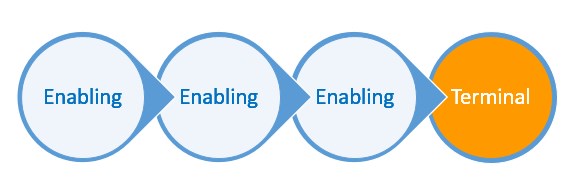
image of process graphic showing 3 enabling objectives ending at a terminal objective
Enabling learning objectives support terminal learning objectives. Image credit: The Peak Performance Center

Terminal (or course learning) outcomes are the broader goals of a course. Enabling (or lesson, module, weekly) objectives are learning objectives for modules or lessons that support learners in achieving learning outcomes. Enabling objectives are the measurable milestones that indicate learners are successfully acquiring knowledge. Here are two examples of terminal and module-level objectives:

In a course for financial wellness:

  • The terminal outcome states, “By the end of this course, learners will develop a strategy to reach their one-year financial goal.”
    • Module 1: Debt Paydown Strategy
      • MLO: By the end of this module, learners will calculate their debt and choose between snowfall, avalanche, and blizzard strategies to pay it down.
    • Module 2: Budgeting Strategy
      • MLO: By the end of this module, learners will analyze their income and determine a percentage budget breakdown model that enables them to live, save, and pay down debt. 

In my mini course for social media marketing for solopreneurs:

  • CLO 2 states, “Learners will devise a content strategy that resonates with the target consumer—their attitudes and behavior patterns—on Facebook, Instagram, and LinkedIn.”
    • Module 1: Social Media Landscapes
      • MLO: By the end of this module, learners will be able to explain the differences between the audience behaviors and engagement on Facebook, Instagram, and LinkedIn.
  • CLO 4 states, “Learners will develop branded content aligned to four content pillars (Educate, Engage, Inspire, Entertain) that support user engagement goals.”
    • Module 1: Content Pillars
      • MLO: By the end of the module, learners will create three (3) content themes aligned to each content pillar.
Overview of Bloom’s Taxonomy

Bloom’s taxonomy is a framework for teaching and assessing learners. It is structured and comprises six levels of thinking in three key domains: cognitive, affective, and psychomotor. The classification system is named for Benjamin Bloom, the academic educational psychologist who developed and published this framework in 1956.
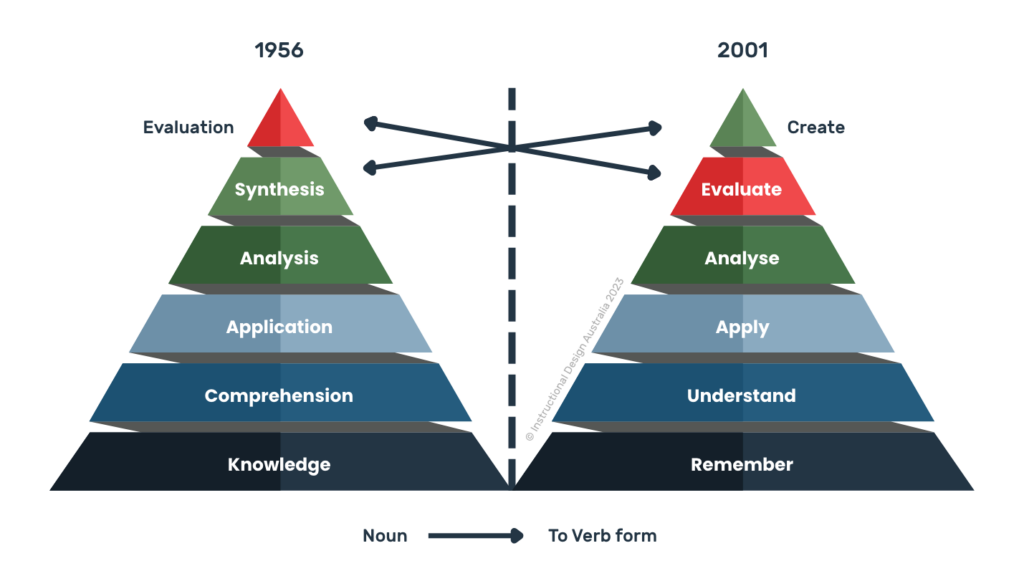
image of Bloom's taxonomy comparing the original 1956 model and the 2001 revised model
Bloom’s taxonomy: the original 1956 model compared to the 2001 Anderson and Krathwohl’s revised model. Image credit: Instructional Design Australia. ‌

The taxonomy structure was revised in 2001 by Lorin Andersen and David Krothwoh, who changed the top two cognitive processes and knowledge types from synthesis and evaluation (1956) to evaluate and create (2001) to adapt to modern educational practices. 

  • CreateThis level of assessment activity reflects the highest-order thinking skills and requires learners to construct original representations of their newly acquired knowledge.
  • EvaluateThis level of assessment activity requires learners to defend a position using newly acquired knowledge or establish criteria by which conclusions are drawn from newly acquired knowledge.
  • AnalyzeThis level of assessment activity requires learners to examine information and organize it or determine relationships within it.
  • ApplyThis level of assessment activity requires learners to solve problems using newly acquired knowledge.
  • UnderstandThis level of assessment requires learners to demonstrate comprehension.
  • RememberThe lowest-order thinking skill in the taxonomy hierarchy that assesses learning through recall methods.