Instructional Design Document

IDD
LDTC - Krystal Ferguson > Instructional Design Document
Minicourse Idea

A Solopreneur's Course for Branding on Social Media

OVERVIEW

Solopreneurs are people who own and operate all aspects of their business alone. Solopreneurs are both the owner and the workforce of their business, assuming responsibility for organizing and managing the risks of their enterprise. Social media marketing is consistently a muddy terrain for solopreneurs who aren’t sure where to start or are overwhelmed by the time commitment they believe is required to be successful. A handful are social media illiterate and apprehensive about using the platform for business. This minicourse addresses these attitudes and barriers.

Solopreneurs, having to wear all hats in their business operations, don’t generally have time to manage social media marketing. They create content and posts because they understand the power and influence of social media, but often don’t have a strategy behind their effort or an understanding of how to interpret engagement data to make better decisions that increase returns on investment—not just ad dollars but time invested in creating content.

KNOWLEDGE GAPS

This course will address four knowledge gaps between solopreneurs and social media marketing:

Where Learners Are Knowledge Gap Evidence of Understanding
Learners haven’t identified a target market, or their market is too broad Developing target market personas based on research of their needs and challenges Learners will use language and imagery that connects to their target audience
Learners think of content as one-size-fits-all where uniform post language, image, and delivery methods are equally effective across all platforms Each social media platform has a unique set of environmental contexts, user attitudes, behaviors, and expectations that affect decision-making A content strategy that leverages these differences for authentic engagement
Learners post/promote content irregularly and inconsistently Strategic social media marketing requires identifying content pillars that make sense for each business Learners will use content pillars for consistent post content and identify tools to aid content scheduling
Learners look to “likes, followers, and reposts/shares” as barometers of content engagement success Spend time with each platform’s data tools to redefine engagement success and a measure of growth Learners will create their own data dashboards that they can use to inform content strategy

TARGET AUDIENCE

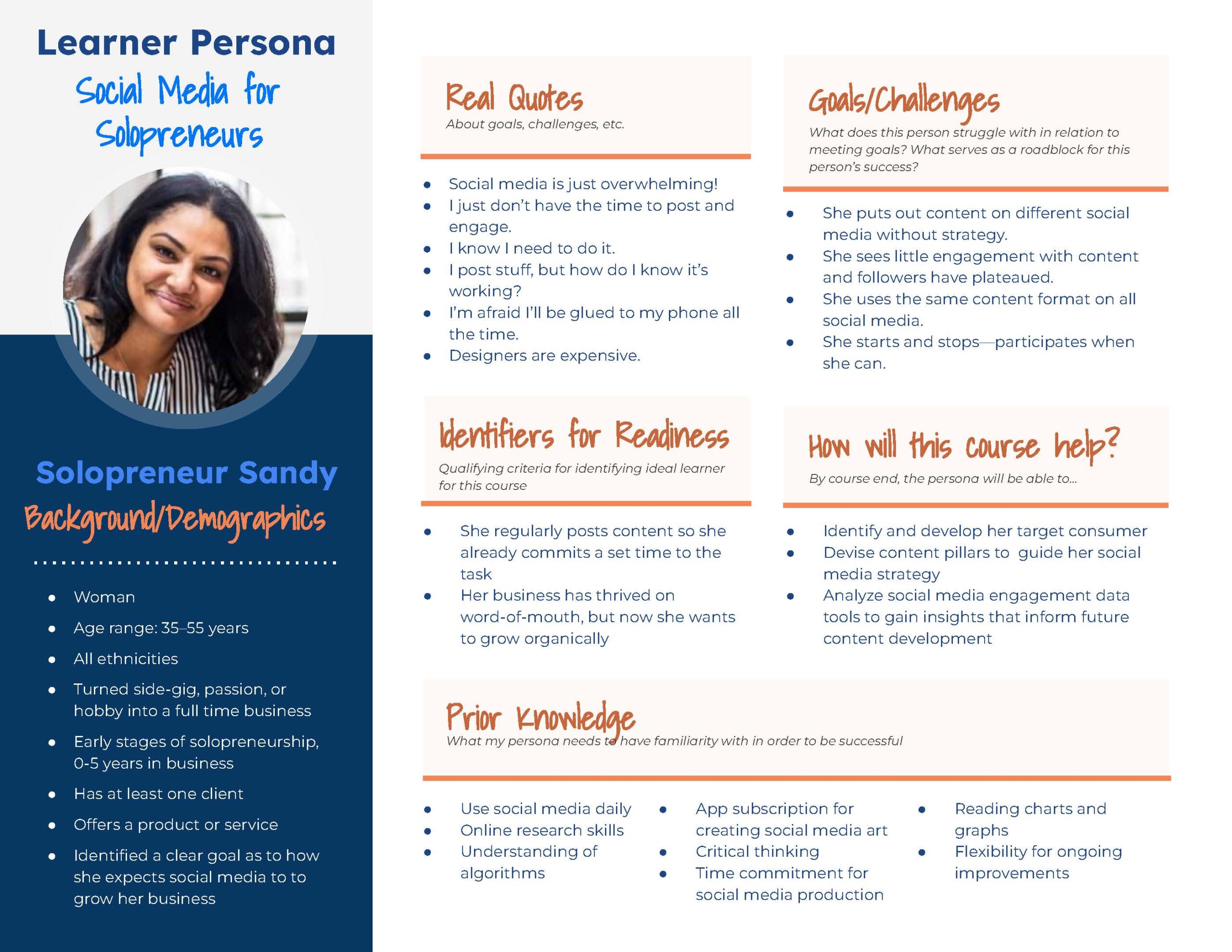
learner persona for social media for solopreneurs minicourse

Download an accessible PDF of this image.

Course Type

This minicourse is an informational course because it teaches solopreneurs a process for developing a strategic marketing plan for social media to reach business growth goals. While the course is informational, learners will be assessed based on their knowledge transfer to the unique needs of their business, reflecting their understanding of the information presented during instruction.

Course Modality

The modality for this course will be synchronous online. Solopreneurs struggle to commit time to social media marketing. These learners are more apt to perform when the demand for their attention is live and consistent. They’ll have an easier time focusing when they’ve committed a block of time to learning and benefit from social interactions with other solopreneurs.

Learning Outcomes

By the end of this course, learners in the Social Media for Solopreneurs Course will be able to:

  • Identify a target consumer who will most likely purchase their product or serviceCLO 1
  • Devise a content strategy that resonates with users on Facebook, Instagram, or LinkedInCLO 2
  • Establish SMART goals for user engagementCLO 3
  • Develop branded content aligned to four content pillars (Educate, Engage, Inspire, Entertain) that support user engagement goals CLO 4
  • Analyze data metrics for consumer engagement insights that inform social media marketing strategyCLO 5

Course Learning Activities (CLAs)

  • [Acquisition] Presentation/Lecture: Develop target user personas for product or service with online research (CLO 1)Students will reflect on their own consumption behaviors through backwards-mapping a recent purchase decision. Following a brief lecture/presentation defining what a target audience is, students will conduct online research about to identify their target audience attitudes and challenges and will transfer their understanding of decision-making to backwards-map the decision-making process for their target audience to purchase their business offering.
  • [Practice] Business Simulation: Content strategy that makes sense for the business offering, social media platform, and target audience (CLO 2)Following a brief lecture/presentation reviewing the demographics of Instagram, Facebook, and LinkedIn, learners will participate in a simulated marketing exercise where they will be given several target personas and business descriptions and match the best target audience and platform for the business described. They will then determine the best platform for their business, audience, and goals.
  • [Inquiry] Socratic Questioning: SMART outcomes for marketing goals (CLO 3)With a solid understanding of platforms and target audience, learners will need to analyze their own businesses to define success for their marketing goals. Questioning will provide clarity on the value of the product or service being offered, or the value of increased engagement resulting from social media content that resonates. Learners will post their drafts on a discussion board for feedback.
  • [Collaboration] PBL: Content plan that educates, engages, inspires, and entertains target audience (CLO 4)Learners will complete a project-based learning exercise. Learners will be split into groups of four and given a company profile including the business offering, target audience, and SMART marketing goal. The groups will choose a social media platform appropriate for the business. Each learner in the group will choose a content pillar and devise three (3) content examples. Their content will describe post content, imagery, delivery format, and case for why it supports marketing goals. Learners will then identify content for each pillar that makes sense for their business.
  • [Discussion] Flipped Classroom: Explore data metrics for engagement insights that measure marketing success (CLO 5)Learning resources will be provided prior to this live session for learners to explore data tools available on the social media platform where they plan to launch their strategy and determine the best metrics to measure the success of their marketing goals. Learners will need to explain how the metrics serve as indicators to marketing success. Learners will then re-evaluate their content to ensure they are aligned to the goals and performance metrics.
  • [Production] Marketing Lab: Launch and learn (CLOs 1, 2, 3, 4, 5)Learners will now launch their social media marketing plans: designing content, producing content, engaging users, and observing metrics. Three live sessions will be used for group discussions, data analysis, troubleshooting, and ideas exchange.

Learning Objectives

Module 1 Topic: Target Personas for Social Media Strategy

Module-Level Objectives (MLOs)
By the end of this module, solopreneurs will:

  • MLO 1: Connect their own decision-making process for a recent purchase to the universal human experience of making buying decisions.CLO 1
  • MLO 2: Develop a target consumer persona reflecting attitudes and behaviors of users with a need for their business product or service.CLO 1, 2, 3
  • MLO 3: Map the decision-making journey for target users on social media who convert to customers because of social media engagement.CLOs 1, 3, 4, 5

Module 1 Learning Activities + Assessments

Map a Recent Purchase Decision

  • Students will reflect on their process for making a recent purchase decision. I will provide a map for learners to map their needs or frustrations for making the purchase, their research experiences that narrowed their choices, in-person experiences (for a car, tool, or investment in learning) that informed their choice, and their feelings about the value of the purchase after it was made.MLO 1

Knowledge Check Reflection Assessment

  • Learners will apply their understanding of the decision-making journey to classify the stages of their recent purchase experience.MLO 1: Formative

Define Your Target Audience

  • Following a brief lecture/presentation defining what a target audience is and evaluating examples of marketing campaigns that successfully market to target audiences, students will conduct online research to identify their target audience avatar. Students will be given a template for their avatar and will be provided with defining criteria, including demographics, needs, attitudes, and challenges. Students will use their research to respond to the criteria.MLO 2:

Target Audience Avatar Project Assessment

  • Learners will demonstrate mastery of research-based target personas that exist in real-world contexts. Learners will activate their critical thinking skills, synthesize information, and develop these personas based on an existing problem their product/service addresses. MLO 2: Summative

Map the Customer Journey to Your Product/Service Purchase

  • By understanding their target persona, learners will map the customer decision-making journey that converts targeted users to consumers of their business product or service.MLO 3

Real-World Simulated Customer Journey Map Assessment

  • Real-World Simulated Customer Journey Map: Learners will synthesize their knowledge of the stages of decision-making and target personas to map a customer journey experience for social media users to convert to consumers of their real-world product or service. MLO 3: Authentic

Course Assessment Strategies

Formative Assessents

  • I will implement knowledge checks following lectures/presentations. I'm positioning myself as a business coach in this course and it's intentional for me to opt-out of quizzes, tests, or anything that might mimic a school context. I will design knowledge check activities in which solopreneurs can immediately connect understanding to real-world processes. Knowledge Checks: CLAs 1, 2
  • The use of discussion boards allows me to evaluate critical thinking skills and empowers solopreneurs to become more familiar with business challenges outside of their own. The change in perspective often enables solopreneurs to think differently and more creatively about their business challenges.Discussion Boards: CLAs 2, 3

Summative Assessments

  • Learners will work collaboratively to create mock social media marketing campaign strategies for fictional businesses. Working collaboratively encourages the exchange of ideas and knowledge gained from previous course modules, assigned reading materials, independent research, and personal/professional experience. These will be assessed using a rubric.Project-Based Collaborative Learning Project: CLA 4
  • With a solid foundational understanding for their social media marketing campaign strategy, learners will be assessed on the effectiveness of using available data tools to quantify success.Flipped Classroom Data Exploration: CLA 5

Authentic Assessments

  • This assessment is where soloprenuers will develop campaign strategies specific to their business and launch their real-world social media campaign, collect feedback in real time, and adjust as needed. I will transition into a facilitator role for this learning activity, offering feedback to guide learners. Marketing Lab Launch and Learn: CLAs 1, 2, 6

Subject Matter Expertise + Resources

Books

Websites

Experts

500 Social Media Marketing Tips: Essential Advice, Hints and Strategy for Business

The Art of Small Business Social Media: A Blueprint for Marketing Success

Social Media Strategy: A Practical Guide to Social Media Marketing and Customer Engagement

SproutSocial
All things related to social media marketing, strategy, engagement, and analytics

Buffer: Social Media for Solopreneurs
Social media management tool with articles related to social media marketing for business

Branding + Social Media Visuals
Krystal Ferguson

Marketing Communications
Fallon Smith

Instructional Design Model

This course will be structured using the Understanding by Design (UbD) framework underscored with collaborative and adaptive elements of the Successive Approximation Model (SAM 1). Its content focuses on understanding, promoting higher-order thinking, meaningful comprehension, and transferable knowledge to business strategy. The SAM model promotes close collaboration among the instructional design team, including the instructional designer, stakeholders, and subject matter experts at the start of the design process, which would serve well stage one of UbD that answers the questions of what knowledge and skills learners should master and what big ideas learners should retain. Another component of SAM that serves the UbD framework of this course is its flexibility and adaptability to revisions informed by stakeholder and learner feedback or changes related to the social media technologies referenced in course content. 

Learning Theories

This course is designed for adult learners, solopreneurs, and the theory driving content development is Andragogy. Solopreneurs are motivated to learn and apply this new skill to grow their business. The subject matter lends itself to immediate application for real-world feedback. The second theory driving learning activity design is Constructivism. Solopreneurs must connect what they already know to what they will learn to reflect understanding.  The final theory fueling assessment is Connectivism. Solopreneurs will learn from each other using virtual learning tools, and from their online/social networks. As they launch their social media marketing campaigns, they will look to the social media response and engagement to assess their success. The course goal is to grow the solopreneur’s business by increasing their Personal Learning Network (PLN), and all three theories will be used during instructional design and development. 

Digital Media