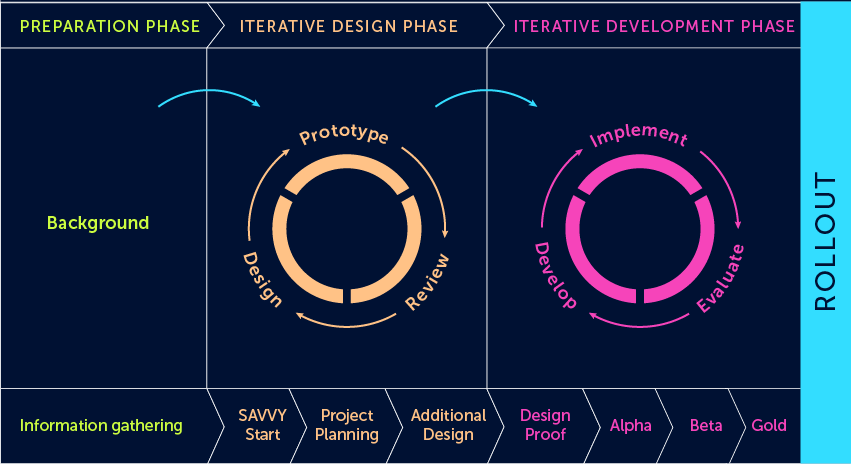
Michael W. Allen developed the Successive Approximation Model (SAM) for Allen Industries as a better instructional model to ADDIE for corporate training. Unlike the linear nature of the ADDIE model, SAM stages are completed in parallel, making it easier to pinpoint errors and resolve them quickly. Three key stages of SAM are outlined below that highlight its collaborative, flexible, and iterative nature.
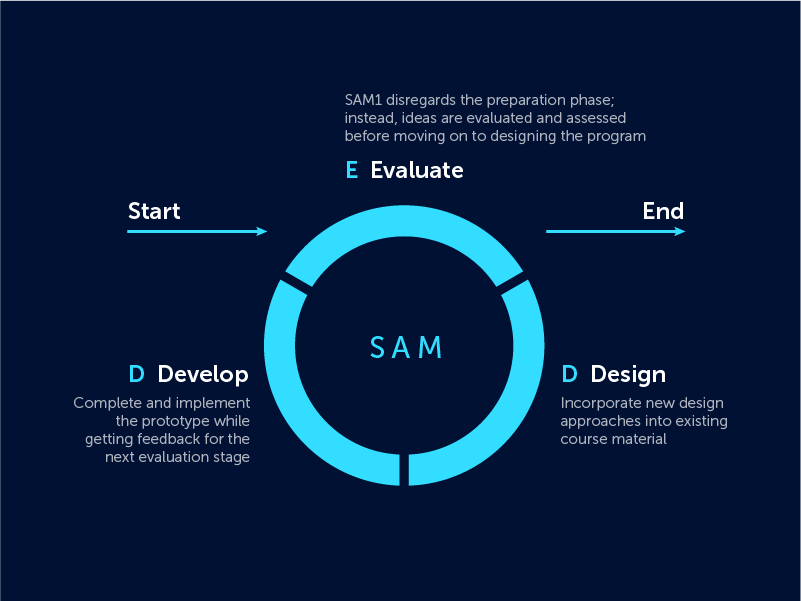
The SAM has two variations: SAM 1 is suitable for smaller projects because it forgoes the preparation phase and begins with evaluating and assessing ideas before design; SAM 2 is ideal for larger, more complex projects that require multiple approvals (Groh, 2022).
Like the RID approach, SAM prioritizes collaboration for success. The model benefits from stakeholder and SME input at the start of course development to identify the most critical knowledge and skills learners need to acquire. By reviewing course prototypes, the instructional design team continuously refines the rough course outline into a finalized version ready for rollout. Working through the stages of SAM in parallel allows the team to work quickly. Adopting prototypes for evaluation incorporates frequent formative evaluation so that improvements are made during the design instead of after the course is deployed. The circular nature of the model characterizes its iterative approach to course design. The feedback loop is ongoing until the Gold version is released.
My minicourse is a corporate training because it intends to close skills gaps for solopreneurs who want to leverage social media marketing to meet their business goals. SAM’s parallel development model is a strength due to the speed at which course prototypes are developed and refined. As social media platforms evolve, revisions to some parts of the course may be necessary. SAM makes it easier to identify and correct errors or update course content without completely starting from scratch. Another strength is high stakeholder collaboration. With the input of SMEs, project sponsors, and other stakeholders during the Savvy Start and iterative development phases, the course design increases the likelihood of delivering a learning experience aligned with learner needs and objectives. SAM is more conducive to course content that teaches soft skills or skills that are harder to quantify, making it a strength for my course since learners are expected to submit different responses on their assessments—with multiple right answers, I’ll need to measure their ability to transfer concepts and knowledge to their business context.
One limitation of SAM is that it’s resource-intensive if the project is complex or large-scale, specifically in the amount of time needed to roll out the Alpha version and/or the amount or cost of personnel participating in the design process. My course would be most suited for the SAM 1 variation because it’s a smaller course with a single or small team of experts.
References
Groh, K. (2022, July 19). SAM (Successive Approximation Model) for Instructional Design [2022]. Valamis. https://www.valamis.com/hub/sam-model
Herrholtz, K. (2020). Rapid instructional design with SAM. eLearning Industry. https://elearningindustry.com/sam-successive-approximation-model-for-rapid-instructional-design
Jay, S. (2024, July 2). ADDIE vs. SAM: Key Differences To Master Training & Development. AIHR. https://www.aihr.com/blog/addie-vs-sam/
Pappas, C. (2021, January 13). ADDIE model vs SAM model: Which is best for your next elearning project. eLearning Industry. https://elearningindustry.com/addie-vs-sam-model-best-for-next-elearning-project