Case-Based Learning is experiential learning that uses real-life scenarios to help students learn. Students are given a case (a problem or situation) and asked to identify the problem, analyze the information, and develop a solution. While there are instances of experiential learning integrated in the scenario, such as implementation of the creative design process which is highly iterative, and project-based learning for delivering creative products, the learning scenario uses a guided-inquiry method to help learners become advocates for a real-world cause, making a case and rallying support from others for their cause. I designed this learning scenario for my Interactive Media Production CTE High School Seniors who I saw for 90-minute blocks daily. I allotted 4 to 6 weeks for each sprint.
This document was provided on the very first day of school. I was the sole program instructor—in their sophomore year, they would’ve had my class on alternating days, but during their junior year, I saw them daily. By the first day of their senior year, we already had relationship and rapport.
This roadmap was meant to serve as an at-a-glance view of their sustained capstone study broken down into design sprints with deadlines. Students were free to work at a pace faster than the specified deadlines provided. I designed a capstone curriculum modeled after case-based learning in which students explored a cause of their choice to design a brand advocacy campaign for. The campaign was broken down into sprints modeled after real-world design processes and each phase had a specified set of tasks and reflections. Students used this roadmap to track and log their own progress. See the roadmap below and my responses to the assessments and learning models incorporated into their year-long capstone journey.
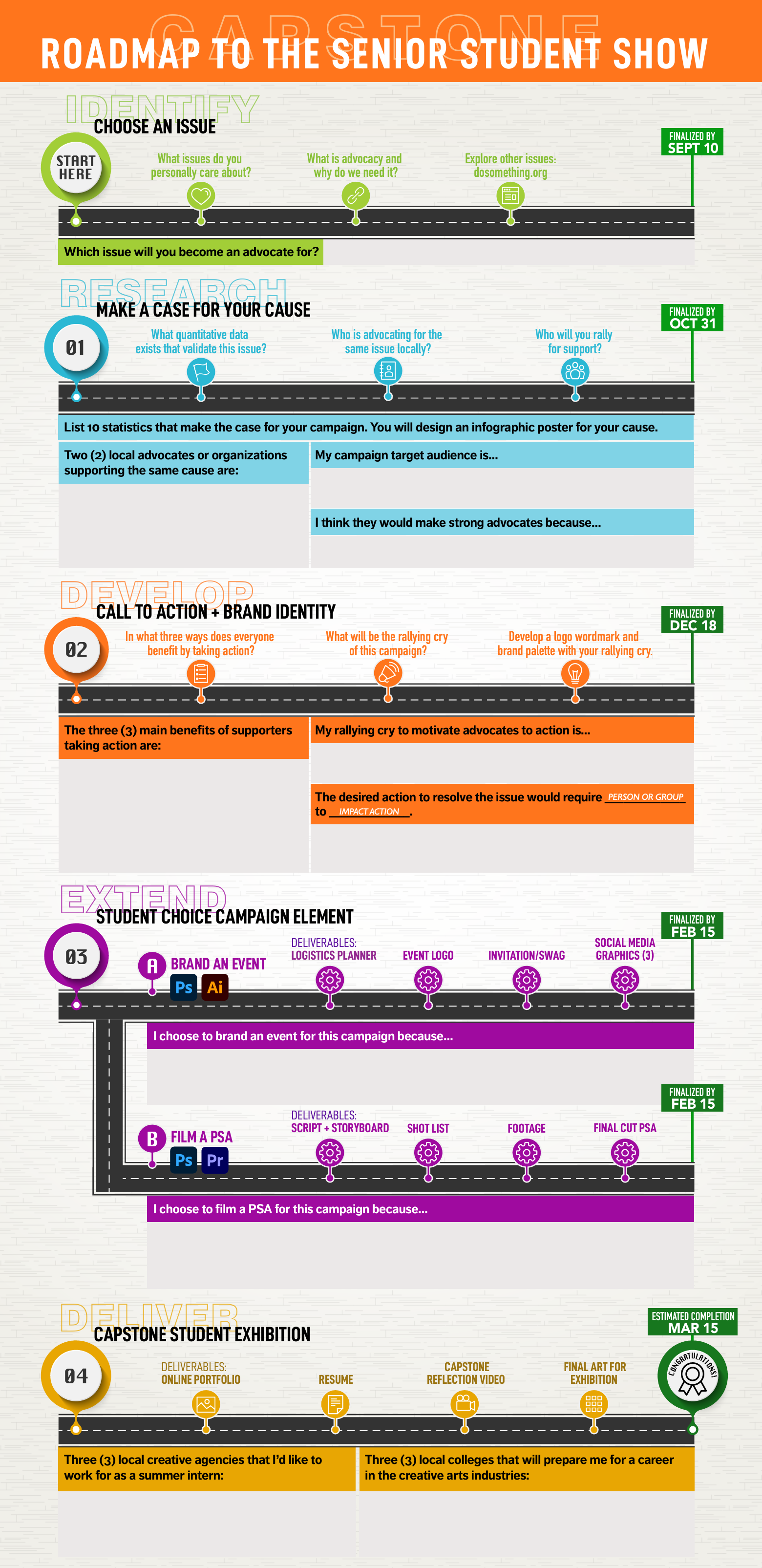
The capstone roadmap names some of the summative assessments in the form of creative project deliverables, as well as online portfolio, resume and reflection. One of of first summative assessments of the year is the research paper—an opportunity for students to develop evidence-based, social advocacy arguments that they could speak confidently about. Some of the formative assessments, or opportunities where I entered the feedback loop and facilitated learning are in the driving questions for each phase. Students also participated in formative assessment during peer critiques. Due to the sustained study, students became increasingly familiar with other student causes and because of their own orientation to the project, could offer constructive feedback to help others improve or share resources that helped them overcome challenges.
There are authentic assessments weaved throughout this learning activity. Students needed to make the case for their social causes they chose by gathering evidence to validate the cause as a serious issue. Students also chose the delivery format that worked best for their career focus in the third sprint, Student Choice Campaign Element. Students who had greater interest in brand and advertising/event design could choose the pathway of an event campaign execution; students with a greater interest in video editing and narratives could choose the digital media pathway. Each pathway had its own rubric specific to the project delivery format. Here again, I followed the iterative creative design process, only offering feedback to support the communication goals they set for their projects. They also needed to reflect on the relevance of their media delivery choices, marrying their interests to their causes.
This learning scenario leverages constructivism as students are working and exploring independently to draw conclusions and reimagine their research as creative deliverables. Not only am I the expert facilitator, but social interactions through peer critique make experts out of all students. Cultivating a classroom context that mirrored a real-world ad agency helped students adopt their roles as professional creatives. Students generally chose causes that were relevant to their life experiences or personal interests, which is an element of cognitivism. Connectivism shows up in brief instances during the research sprint for the campaign, and in the final student presentation where I asked students to identify local businesses and organizations they can add to their PLN. Each sprint was facilitated using Gagne’s Nine events of Instruction in which many of the concepts presented were related to critical thinking and data analysis skills, connecting current learning to real-world examples of its implementation, as well as practicing professional soft skills pertinent to creative industry success.